
Archive

June 5, 2026

Browsing

The Trump administration has proposed new tariffs of up to 12.5% on imports from 60 economies after determining they had failed to curb trade in goods ‌made with forced labor, an assertion that was rejected by its trading partners.

The proposal from the U.S. Trade Representative’s office, issued late on Tuesday, comes from a Section 301 unfair trade practices investigation designed to help rebuild U.S. President Donald Trump’s emergency tariffs, struck down by a U.S. Supreme Court decision in February.

Despite laws banning them, the products of forced labor are deeply embedded in supply chains around the world. But European lawmakers in particular bristle at the ​accusation that the region is less effective than the U.S. at curbing the trade in such goods, with one describing the U.S. findings as “utterly absurd.”

The USTR proposed 10% additional ​duties on imports from Canada, Ecuador, the European Union, Indonesia, Mexico, Pakistan, Argentina, Bangladesh, Cambodia, El Salvador, Guatemala, Malaysia, Taiwan and Britain. The USTR said ⁠all had plans or partial schemes in place.

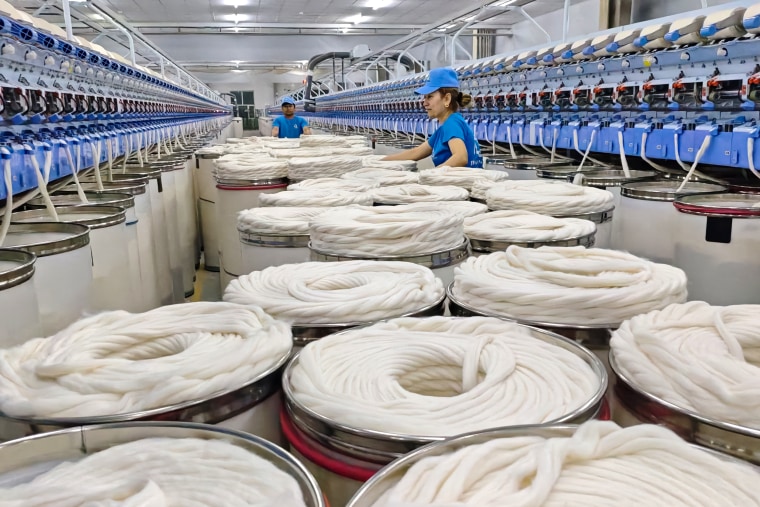
Employees work on the spinning production line at a workshop of a textile factory in Xinjiang Uygur Autonomous Region of China on March 5.Bao Liangting / VCG via Getty Images file

The trade agency said it would impose additional duties of 12.5% on the remaining 45 countries that it investigated. These include China, India, Nigeria, Japan, ​South Korea, Vietnam, Australia and New Zealand.

“The failure of our most important trading partners to address the importation of goods made with forced labor is unacceptable,” U.S. Trade Representative Jamieson Greer said in a ​statement. “This creates a dynamic where American workers are forced to compete globally on an unlevel playing field.”

The USTR said it would accept public comments on the proposed tariffs and other remedies through July 6, with a public hearing scheduled for July 7.

The announcement comes ahead of the July 24 expiration of a 10% temporary tariff imposed by the Trump administration on Feb. 20, the day the Supreme Court struck down Trump’s ​tariffs under the International Emergency Economic Powers Act.

The European Commission said the tariffs were unjustified and reiterated its commitment to the trade deal sealed with Washington last year.

Bernd Lange, the chair of the European ​Parliament’s trade committee, which voted on Tuesday to accept that trade deal, said the new tariffs were expected, but said the results of the U.S. investigation were still “utterly absurd” given a 2024 E.U. law to ban imports ‌of forced labor ⁠products.

“The impression is increasingly emerging that a tariff measure is sought first, and only then is a suitable legal justification found,” he said. However, he added that the key question would be whether the additional tariffs would exceed those agreed between both sides last July.

The U.S.’s largest trading partner, the European Union, agreed last July to accept tariffs of 15% on a broad range of its exports. In its report, the USTR said the E.U. measures came into force only in December 2027 and lacked key elements.

“We know there are ups and downs in what people say,” French Finance Minister Roland Lescure ​told reporters after a Cabinet meeting. “But the goal ​is to ratify the (trade) accord and stick ⁠to that.”

Britain said it was in regular talks with the United States and was taking action to tackle forced labor. It added that the preferential access to U.S. markets that it had negotiated for U.K. businesses remained in place.

Taiwan said it was “hopeful and confident” that the final results would reflect agreements ​already reached, securing relatively preferential treatment.

Beijing, facing 12.5% tariffs, said that it opposed all forms of unilateral tariffs and that there was no forced labor ​in China. India, confronted with ⁠the same rate, said it was engaged with Washington on the Section 301 proceedings, noting the proposed tariffs were not final.

On Monday, the USTR proposed a 25% duty on many Brazilian goods as a result of a Section 301 investigation into the country’s digital trade practices and preferential tariffs.

The trade agency is also expected to soon unveil the findings of another major Section 301 probe into the buildup of excess industrial capacity ⁠in 16 trading ​partners, including China and the European Union.

In the forced labor findings, the USTR said it would exempt from tariffs ​products including energy, rare earths and some other metals, beef, coffee, certain fruits and vegetables, pharmaceuticals, organic chemicals and aircraft parts.

It also said it was proposing a textile mechanism that would allow for a certain volume of apparel and textile imports ​to enter the U.S. at a reduced tariff rate, without giving details.
When the U.S. men’s national soccer team plays at home, its most loyal fans traditionally sit right behind a goal to cheer on the team or intimidate the opposition.

But when the Americans kick off a once-in-a-generation World Cup in Southern California next week, many of those die-hard supporters may be harder to hear because FIFA seated them in the “nose bleeds,” according to a major U.S. fan group.

“These are the worst tickets that I’ve ever seen out of the five World Cups I’ve been to,” American Outlaws President Brian Hexsel said in a phone interview.

FIFA’s World Cup ticketing rollout has faced withering criticism for months, particularly for its sky-high prices. There have also been allegations that some ticket buyers got worse seats than expected, sparking investigations in New York and New Jersey.

In the blowback, soccer’s global governing body announced a small allotment of $60 tickets for each of the tournament’s 104 matches.

FIFA didn’t immediately comment for this article.

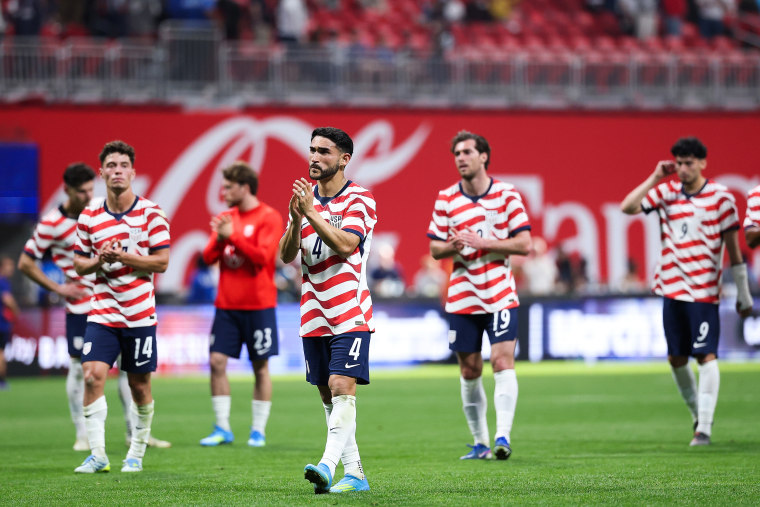
Cristian Roldan, center, and the U.S. team applaud fans after their loss to Belgium at Mercedes-Benz Stadium on March 28.Kevin C. Cox / Getty Images

Participating member associations, including U.S. Soccer, would manage “the selection and distribution process,” said FIFA, which emphasized it was asking the associations to “ensure that these tickets are specifically allocated to loyal fans who are closely connected to their national teams.”

The American Outlaws are such fans. The organization says it has more than 200 chapters worldwide sharing one goal: cheering on U.S. Soccer’s teams. The group travels to matches with hand-painted banners, a giant American flag, drums and organized chants — all of it typically on display right behind the net.

But this summer, American Outlaws members with $60 tickets will be in upper decks at each of the team’s three group stage matches, Hexsel said. That seating arrangement means some of the most fervent fans will be physically farther from the pitch, potentially making it harder for players to hear their shouts.

Hexsel said U.S. Soccer told him Monday that the $60 seats will be in sections 302 through 310 for the team’s first match against Paraguay at Los Angeles County’s SoFi Stadium, sections 310 through 315 in Seattle’s Lumen Field for the second match against Australia and section 426 for the third match back at SoFi against Turkey — putting fans even higher than they’d be seated for the first match.

U.S. Soccer told NBC News the $60 tickets are in sections 306 through 310 for the Paraguay match, sections 302 through 304 for the Australia match and sections 426 through 431 against Turkey. It didn’t provide further comment.

When the tickets started landing in people’s accounts Monday night, “my phone just blew up,” Hexsel said. “Everybody was pissed.”

It’s not clear whether fan groups for the World Cup’s other competing countries have been affected in the same way.

Juan Felipe Garay, coordinator of Colombia’s biggest supporters’ group, Fiebre Amarilla, told NBC News the group doesn’t yet know where its $60 seats will be for Colombia’s matches.

But Hexsel said that without question, for the American die-hards, a World Cup in their own backyard now “does not feel like we are playing in the U.S.”

South Florida superfan Burak, who asked that his last name not be published for privacy, told NBC News on Monday night that a ticket in the “400s” showed up in his account for the third U.S. match.

Burak said he laughed with his wife about the situation and hadn’t expected better seats. He prefers being high up at a match when he’s trying to “read the play.” But, he said, watching is secondary to making an impact when you’re in the supporters’ section.

“If you’re up at nosebleed 400s, your reaction doesn’t even matter. No one’s going to hear, see or notice,” he wrote in a text message.

Another U.S. fan, Gabriel Miguel, said, “I thought it could be worse.”

Miguel scored $60 tickets to the opening U.S. match against Paraguay. He’ll be in section 308 and said he’s “mostly grateful” just to be in the building.

“I would love to have been down in the lower action, but I mean, 300s is perfectly fine, especially for that price.”

American supporter Logan Pedersen said, “We could have been higher up … not by far.”

Pedersen said in a phone interview that he got “the golden ticket,” getting to see the opening U.S. match at such a relatively low cost. He’s “just glad to be in the stadium,” but he also said FIFA’s ticketing “process has been a nightmare.”

“It’s still super disappointing from FIFA that they’re not at least designating a section for, you know, 500 fans from each team directly behind the goal. I think it’s a huge loss for the atmosphere that’s gonna go on in the stadium,” he said.

Hexsel said of the seating arrangements, “It just means we gotta bring more drums and more noise to show the team that … we still showed up.”

“FIFA could have just said: ‘Hey … it’s 300, it’s 200. Yeah, it’s a little bit more than what you paid in Qatar, but you guys have a block of seats where you’ve always had a block of seats,’ and people would have paid it.”

Burak said by text message: “I’m just glad I can at least go to some games with the supporter price. I accept my small guy status. If we had a strong community, I’d be all about boycotting the WC all together. But that’s not how people are, that will never happen. And Fifa is feeding off of that. They know someone will show up.”

Said Miguel: “I’m happy to be going, at least, and it’s more like memories than anything. Could it be better? Of course. But … they dropped the ball from the beginning with this. It’s … nothing surprising at this point.”